How Many Supplements Is Too Many? What the Science Says

Key Takeaways
- A durable routine you keep up for years does more for healthy aging than chasing the newest or most exotic supplement.
- Taking too many supplements every day can quietly undermine the routine, because adherence drops as the daily pill count rises.
- Many oversized routines duplicate the same antioxidants and minerals across bottles, increasing cost and complexity without adding coverage across the Four-Pillar Framework (Signal, Shield, Power Plant, and Cleanup).
- For healthy aging, the routine you actually sustain for years matters more than the routine you designed on paper.
- A smaller, complementary daily formula, taken consistently with food, is often a smarter way to support cellular health and longevity.
Why Are So Many People Taking Too Many Supplements?
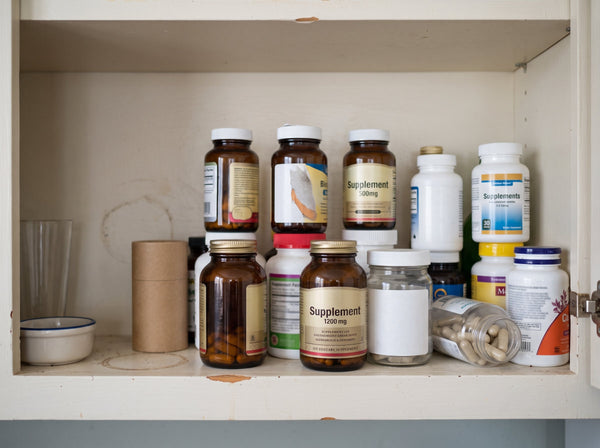
The shelf above the kitchen counter keeps growing. There’s the foundational multivitamin from a few years ago. The fish oil added after a podcast. Magnesium glycinate for sleep, NAC for liver, three different polyphenols for “longevity,” a stand-alone vitamin D, an extra C for winter, and the bottle of something a friend swears by. The cabinet of bottles is now 8, 10, sometimes 12+ products deep, and the morning routine has turned into a juggling act. If you’ve quietly wondered whether you’re taking too many supplements, you’re not the only one asking.
The pattern is real, and it concentrates exactly where you’d expect. Recent national survey data shows that more than half of US adults use a dietary supplement, and the rate climbs with age, education, and income; among women aged 60 and over, the figure is closer to four in five. The “stack culture” of the last decade reframed an informed health routine as a longer ingredient list, and the cabinet of bottles grew to match. The observation that most health-conscious adults now take 8 to 12 supplements a day is what led to the founding of ResilienZ Health. What started as evidence-aware self-care has, for many readers, drifted into supplement clutter.
The cost adds up too. Ten premium supplements at typical retail can run several hundred dollars a month, and the question of how many supplements is too many starts to look as much like a budget question as a biology one.
How Pill Burden Affects Supplement Adherence
A daily supplement routine that actually works is only useful if it actually happens. Most don’t. The capsule that does nothing is the one you forgot to take on Wednesday and again on Saturday. As the morning lineup grows, the percentage of doses actually taken slips, and the routine starts producing less of the benefit it was designed for. Supplement adherence, in other words, is the hinge the whole routine swings on.
The pharmaceutical research on this is decades deep and consistent. As the number of separate doses required per day rises, daily adherence declines in a steady, dose-dependent way (the more daily doses a routine requires, the lower the adherence). Once-daily routines see the highest adherence; routines requiring three or four separate dosing events through the day see the lowest. Supplements lack the urgency of prescription medications, so the pill-burden penalty almost certainly applies more severely in this category, even though the supplement-specific evidence base is thinner. The pill-burden literature also suggests that taking too many supplements has a measurable cost on supplement adherence, even when the ingredients are well-chosen.
 |
The science: As the number of separate doses required per day rises, the percentage of doses actually taken falls. Adherence is highest with once-daily routines and degrades steadily with each additional daily dose. The evidence: A widely cited systematic review of daily-dose and compliance studies reported clear, dose-dependent declines in adherence as daily dose frequency increased: about 79% adherence with once-daily dosing, 69% with twice-daily, and 65% with three-times-daily (Claxton, Cramer, & Pierce, 2001). |
Habit research adds the second piece of the picture. Real-world tracking of new health behaviors found it takes an average of 66 days for habits to become automatic, with simpler actions becoming automatic faster than complex ones. A multi-bottle supplement routine that demands selection, sequencing, and timing throughout the day takes longer to become habitual, if it ever does. The complexity is itself a tax on supplement adherence.
Why Taking Too Many Supplements Often Means Overlap and Supplement Interactions
Supplement routines tend to grow in redundancy more than in coverage. Three different bottles of vitamin C. Two forms of vitamin E. Several polyphenols at trace doses scattered across two or three “longevity” routines. The case for a simpler routine is a case for disciplined formulation thinking. When taking too many supplements becomes the norm, the redundancy and the supplement interactions both become harder to manage.
Redundancy hides inside premium routines because the labels rarely show it directly. A multivitamin contains vitamin C, several B vitamins, vitamin D, vitamin E, and a list of minerals. A buffered C bottle adds more vitamin C; a third “antioxidant complex” includes still more. Vitamin E often appears as alpha-tocopherol alone in two bottles, missing the broader vitamin E family of mixed tocotrienols and tocopherols that human research suggests does the most useful work together. Polyphenols like resveratrol and quercetin show up at 50 mg trace amounts that sit well below the doses studied in published research or use less effective forms to cut costs.
The right number of supplements is whatever number you’ll actually take, every day, for years.
| Common bottle | What it adds | What it duplicates |
|---|---|---|
| Multivitamin | Vitamins C, D, E, B-complex, minerals | The baseline most other bottles re-cover |
| Buffered vitamin C | More vitamin C | Vitamin C already in the multivitamin |
| Antioxidant complex | Vitamin C, polyphenols | Vitamin C again, plus polyphenols at trace doses |
| “Longevity” blend | Resveratrol, quercetin | Trace doses below studied levels |
| Standalone vitamin E | Alpha-tocopherol | A form already partly in the multivitamin |
Supplement interactions add the second cost. Some are well-documented: calcium interferes with iron absorption, vitamin K affects anticoagulant medications, and the fat-soluble vitamins jostle for the same absorptive pathway. Others are subtler and harder to track once a daily routine has 8 or 10 products in it. Tracking supplement interactions across a complex daily supplement routine is harder than it sounds, even for clinicians.
| Pairing | What happens | Practical note |
|---|---|---|
| Calcium and iron | Compete for absorption | Space them apart rather than taking them together |
| Vitamin K and anticoagulants | Vitamin K affects blood-thinning medication | Worth a word with your clinician before combining |
| Fat-soluble vitamins (A, D, E, K) | Share the same absorptive pathway | Take with a meal that contains some fat |
Dose is the other half of the equation. An active ingredient at a clinically credible, research-aligned dose is what produces effects; at a fraction of that dose, the same ingredient mostly serves the label. Naming every ingredient and its dose, rather than tucking amounts inside a blend, is the formulation discipline ResilienZ Health builds around.
How Many Supplements Is Too Many? What a Daily Supplement Routine That Actually Works Looks Like
The principle the science keeps pointing to is simple, even if it isn’t easy. The right number of supplements is the smallest number that covers the relevant cellular pathways at credible doses, in forms the body can actually use, anchored to a daily cue you already perform. The argument is for fewer ingredients, better chosen, taken consistently. Healthy aging is the long game, and routine wins it.
So how many supplements is too many in practice? The obvious answer is whatever amount makes the routine fragile. If your daily supplement routine is duplicating ingredients across bottles, slipping past you on busy weeks, or quietly costing several hundred dollars a month, the routine is doing less than it could. A consolidated stack, anchored to your largest meal so the fat-soluble active ingredients absorb properly, will almost always outperform a sprawling one over the years that matter. The case against taking too many supplements is a case for fewer ingredients chosen with more care.
Aging happens through multiple, distinct cellular processes at once. Decades of research on the hallmarks of aging point to a small number of these processes (oxidative stress, mitochondrial decline, impaired cellular renewal, and a few others) that together drive how the body changes over time. Cellular renewal in particular relies on two housekeeping processes: autophagy, which recycles worn-out cell parts, and senolysis, which clears senescent cells that won’t die off on their own. Both slow with age.
Each cellular process responds to different inputs. Vitamin E works in fat-soluble environments, while vitamin C works in water-soluble ones. CoQ10 (coenzyme Q10) supports mitochondrial energy in a way no antioxidant alone can. A smarter daily supplement routine builds for breadth across those cellular mechanisms at credible doses, with fewer supplement interactions to track along the way.
ResilienZ-12™ follows that principle. Twelve complementary ingredients sit across the formula’s four formulation pillars, each covering a distinct cellular role:
- Signal (cellular communication)
- Shield (oxidative balance)
- Power Plant (mitochondrial energy)
- Cleanup (autophagy and senolysis)
ResilienZ-12™ comes in three vegan capsules, ideally taken with the largest meal. The simpler routine is also the more disciplined one, and it’s the one most likely to still be in place a decade from now.
Frequently Asked Questions
Is Taking Too Many Supplements Bad for You?
Taking too many supplements is not automatically harmful, but it can be wasteful and self-defeating. As the daily count rises, supplement adherence falls and redundant ingredients pile up. The bigger risk is a routine you stop following rather than a serious overdose, though some fat-soluble vitamins and supplement interactions do warrant attention.
How Many Supplements Is Too Many to Take in a Day?
How many supplements is too many depends on the person, but a useful test is whether the routine is sustainable. If the daily pill count is forcing tradeoffs, duplicating ingredients across bottles, or quietly slipping past you on busy weeks, the routine is doing less than it could. Smaller, complementary stacks tend to be more durable.
Why Does My Supplement Routine Keep Growing?
A daily supplement routine that actually works tends to fail when each new ingredient is added in isolation. Without a formulation principle, the cabinet of bottles expands by accumulation, and the duplicates stay invisible to the buyer.
Is It Better to Take One Multi-Ingredient Supplement or Several Single-Ingredient Ones?
A well-designed multi-ingredient supplement is often the better choice for daily, long-term use because it combines complementary active ingredients at credible doses in a single routine. Single-ingredient products make sense for specific medical needs (prescription-grade omega-3, vitamin D for documented deficiency, B12 for vegans) where the dose and timing are individually managed.
How Can I Simplify My Daily Supplement Routine That Actually Works?
To simplify a daily supplement routine that actually works, audit the cabinet for duplicated ingredients, drop trace doses that exist mostly for label appeal, and look for one well-formulated daily stack that covers complementary cellular pathways at research-aligned doses. Anchor what remains to your largest meal so it becomes automatic.
FDA Disclaimer
These statements have not been evaluated by the Food and Drug Administration. This product is not intended to diagnose, treat, cure, or prevent any disease.
A simpler daily routine for healthy aging
Twelve complementary ingredients at clinically credible doses, in three vegan capsules. Built for daily use, priced for it.
Start Your Routine TodayReferences
Boullata, J. I., & Hudson, L. M. (2012). Drug-nutrient interactions: A broad view with implications for practice. Journal of the Academy of Nutrition and Dietetics, 112(4), 506–517.
Claxton, A. J., Cramer, J., & Pierce, C. (2001). A systematic review of the associations between dose regimens and medication compliance. Clinical Therapeutics, 23(8), 1296–1310.
Hallberg, L., Rossander-Hulthén, L., Brune, M., & Gleerup, A. (1993). Inhibition of haem-iron absorption in man by calcium. British Journal of Nutrition, 69(2), 533–540.
Lally, P., van Jaarsveld, C. H. M., Potts, H. W. W., & Wardle, J. (2010). How are habits formed: Modelling habit formation in the real world. European Journal of Social Psychology, 40(6), 998–1009.
López-Otín, C., Blasco, M. A., Partridge, L., Serrano, M., & Kroemer, G. (2013). The hallmarks of aging. Cell, 153(6), 1194–1217.
López-Otín, C., Blasco, M. A., Partridge, L., Serrano, M., & Kroemer, G. (2023). Hallmarks of aging: An expanding universe. Cell, 186(2), 243–278.
Mishra, S., Stierman, B., Gahche, J. J., & Potischman, N. (2021). Dietary supplement use among adults: United States, 2017–2018 (NCHS Data Brief No. 399). National Center for Health Statistics.
Reboul, E. (2017). Vitamin E bioavailability: Mechanisms of intestinal absorption in the spotlight. Antioxidants, 6(4), 95.
Office of Dietary Supplements, National Institutes of Health. Multivitamin/mineral supplements: Fact sheet for health professionals.
About the author: Seanna Marceaux, MS RDN, is ResilienZ Health’s Chief Science Officer and the dietitian who vetted the ResilienZ-12™ formulation. A Texas-licensed registered dietitian nutritionist with nearly 20 years in public health and aging, she holds a master’s degree in Human Nutrition from Texas State University, where she teaches graduate nutrition courses, and she has published peer-reviewed research on nutrition and aging.
More about Seanna’s background, research, and role at ResilienZ Health